Gift for Them
Gift for Them
Gift for Them
MoMA Design Store Pipeline for Artwork-Product Generation
MoMA Design Store Pipeline for Artwork-Product Generation
MoMA Design Store Pipeline for Artwork-Product Generation
The project investigates how AI can translate artworks into functional products without relying on literal visual reproduction. The system uses a vision language model to extract structured information from artworks, including form, color, and conceptual attributes, and generates multiple product directions based on distinct translation logics. Outputs are evaluated through a rule-based framework designed to test whether a product captures the behavioral or conceptual qualities of an artwork rather than merely resembling it. To test the system in reverse, a second pipeline applies museum-style curatorial reasoning to everyday consumer products, generating speculative labels, classifications, and gallery placements to examine how artistic value is constructed.
The project investigates how AI can translate artworks into functional products without relying on literal visual reproduction. The system uses a vision language model to extract structured information from artworks, including form, color, and conceptual attributes, and generates multiple product directions based on distinct translation logics. Outputs are evaluated through a rule-based framework designed to test whether a product captures the behavioral or conceptual qualities of an artwork rather than merely resembling it. To test the system in reverse, a second pipeline applies museum-style curatorial reasoning to everyday consumer products, generating speculative labels, classifications, and gallery placements to examine how artistic value is constructed.
The project investigates how AI can translate artworks into functional products without relying on literal visual reproduction. The system uses a vision language model to extract structured information from artworks, including form, color, and conceptual attributes, and generates multiple product directions based on distinct translation logics. Outputs are evaluated through a rule-based framework designed to test whether a product captures the behavioral or conceptual qualities of an artwork rather than merely resembling it. To test the system in reverse, a second pipeline applies museum-style curatorial reasoning to everyday consumer products, generating speculative labels, classifications, and gallery placements to examine how artistic value is constructed.
ROLE
ROLE
ROLE
Concept Development, Prototyping, AI Assisted Design
Concept Development, Prototyping, AI Assisted Design
Concept Development, Prototyping, AI Assisted Design
SKILLS
SKILLS
SKILLS
Product design
Concept development
Prototyping
Product design
Concept development
Prototyping
Product design
Concept development
Prototyping
TIMELINE
TIMELINE
TIMELINE
2026
2026
2026
TOOLS
TOOLS
TOOLS
Vision-language models, rule-based evaluation
Vision-language models, rule-based evaluation
Vision-language models, rule-based evaluation
TEAM
TEAM
TEAM
Yutong Wang, Harvard GSD MDes Mediums
Yutong Wang, Harvard GSD MDes Mediums
Yutong Wang, Harvard GSD MDes Mediums
01 Inspirations
01 Inspirations
01 Inspirations
A survey of existing museum merchandise where the painting’s surface gets stamped onto the product, but its meaning rarely makes the trip.
A survey of existing museum merchandise where the painting’s surface gets stamped onto the product, but its meaning rarely makes the trip.
A survey of existing museum merchandise where the painting’s surface gets stamped onto the product, but its meaning rarely makes the trip.
Pipeline — Artwork to Product
Pipeline — Artwork to Product
Pipeline — Artwork to Product
The system uses a vision-language model to extract structured information from each artwork, including form, color, and conceptual attributes, as the basis for downstream product generation.
The system uses a vision-language model to extract structured information from each artwork, including form, color, and conceptual attributes, as the basis for downstream product generation.
The system uses a vision-language model to extract structured information from each artwork, including form, color, and conceptual attributes, as the basis for downstream product generation.
Scroll Left
Scroll Left

02 Pipeline — Artwork to Product
02 Pipeline — Artwork to Product
02 Pipeline — Artwork to Product
Each artwork’s analysis branches into multiple product directions, one for each translation logic. A rule-based framework then evaluates every output, testing whether the product captures the artwork’s behavioral or conceptual qualities rather than merely resembling it.
Each artwork’s analysis branches into multiple product directions, one for each translation logic. A rule-based framework then evaluates every output, testing whether the product captures the artwork’s behavioral or conceptual qualities rather than merely resembling it.
Each artwork’s analysis branches into multiple product directions, one for each translation logic. A rule-based framework then evaluates every output, testing whether the product captures the artwork’s behavioral or conceptual qualities rather than merely resembling it.
03 Reverse Pipeline — Product to Artwork
03 Reverse Pipeline — Product to Artwork
03 Reverse Pipeline — Product to Artwork
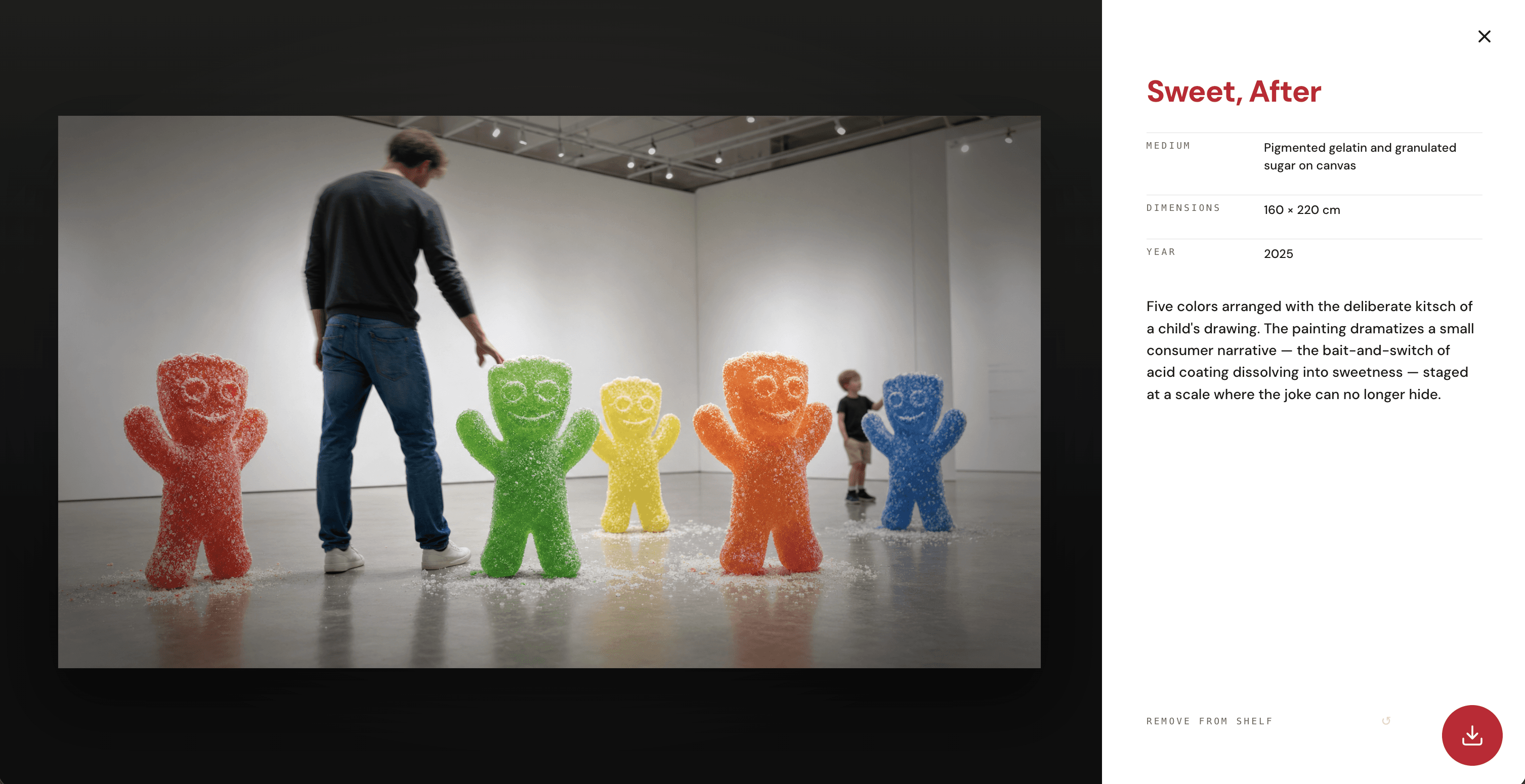
A second pipeline reverses the logic, applying museum-style curatorial reasoning to everyday consumer products, generating speculative labels, classifications, and gallery placements to examine how artistic value is constructed.
A second pipeline reverses the logic, applying museum-style curatorial reasoning to everyday consumer products, generating speculative labels, classifications, and gallery placements to examine how artistic value is constructed.
A second pipeline reverses the logic, applying museum-style curatorial reasoning to everyday consumer products, generating speculative labels, classifications, and gallery placements to examine how artistic value is constructed.
Reverse Pipeline
Reverse Pipeline
Reverse Pipeline